Welcome!
Here you will find an overview of the newsletters published so far.
Newsletter 1; It Started with Notes and Articles
To be honest, I never intended to write a book.
During my years at Efteling and Europa-Park, I constantly took notes and collected interesting articles. What fascinated me most was the psychological side of a theme park visit. I was less interested in the height of a roller coaster, the number of G-forces, or its top speed, but always wanted to understand why these attractions have such a profound impact on us.
What happens in our bodies and minds when we experience excitement, wonder, or joy? And what role do music, entertainment, employees, architecture, landscape design, and even trees and plants play in creating those feelings?
Gradually, I came to realize that a theme park visit might take place just as much in our minds as it does in the park itself.
During the COVID-19 pandemic, I finally had the time to explore these questions in greater depth. This led me to the scientific literature on experiences, a concept frequently used within the attractions industry, yet not always defined in the same way. To truly understand the phenomenon, it is important to know which perspective one takes when examining an experience.
Types and Levels of Experiences
A park may announce that it has added a new show experience to its offering. But does that automatically mean visitors will have a remarkable experience?
Not necessarily.
The literature distinguishes between the experience that an organization designs and offers, and the experience that a visitor actually has. The first can be viewed as a stimulus; the second as a response.
It is precisely this response that most theme parks aim to create.
But what exactly constitutes a lived experience? That question led me on a search for the building blocks of memorable experiences. Ultimately, I identified eight key elements and translated them into a practical tool: the Visitor Experience Checklist.
For each of these building blocks, I searched for deeper insights. Why do some themes work better than others? Why is it beneficial to engage multiple senses simultaneously? And how do you make an experience truly memorable?
Creating the Theme Park Experience Model
The checklist turned out to align remarkably well with the many notes and articles I had collected over the years.
In theme parks, almost everything contributes to the guest experience. From colour schemes to music. From food and beverages to signage. From marketing before a visit to the memories visitors take home with them afterwards. Very little is left to chance.
By combining these observations with different types and levels of experiences, the Theme Park Experience Model (TPEX) gradually emerged. The model illustrates how a theme park experience is created step by step and how its various components influence one another.
Writing, Rewriting, and Cutting
Two years ago, I realized that my collection of notes had grown into a document of roughly two hundred pages. What had originally started as a project during the pandemic was beginning to look more and more like a book.
I cautiously shared the manuscript with a few readers. Their enthusiastic reactions motivated me to continue. Using their feedback as a starting point, I rewrote the text and then submitted it to Pieter Cornelis and Wim Strijbosch.
As lecturers at Fontys University of Applied Sciences and Breda University of Applied Sciences, and as recognized experts in the field of theme parks, I felt that their opinions would carry significant weight. Fortunately, their response was highly positive. In fact, both offered to actively contribute to the development of the manuscript.
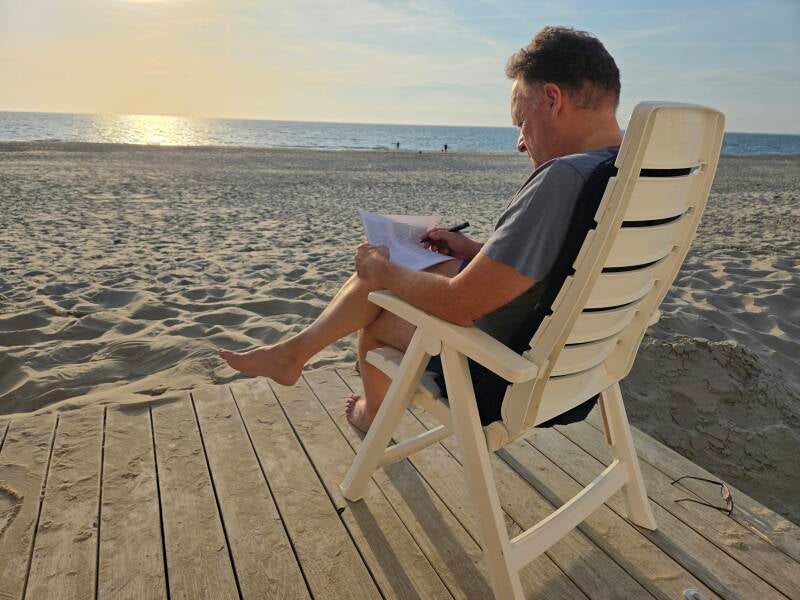
Some chapters required additional depth, while others could be shortened. Over several workshops, we refined and sharpened the content.
At times it felt like taking three steps forward and two steps back, but the result became stronger with every revision.
Another extensive rewriting phase followed, this time including all references and citations. One important lesson I learned along the way:
if you are planning to write a book, it is best to start organizing and documenting your sources from day one.
Just a Little More Patience...
The book is now at the printer, and I cannot wait to hold the first printed copy in my hands. The official presentation will take place on 27 November 2026. In the next newsletters, I will tell you more about how you can get your copy and where the book will be available.
Until then!
Henk Groenen
Unravelling the Theme Park Experience: Turning Moments into Memories